Practical guide
Compare Journal Weeks With Unequal Notes: Choose the Right Denominator
Compare two unequal sets of journal notes using a complete fifteen-entry example. Entry and represented-date fractions give opposite ordering; missing events remain unknown.
Different amounts of writing need a clearly named comparison
When two journal weeks contain different numbers of notes, start with the question rather than the biggest count. “How many selected entries mention this sequence?” and “On how many represented dates did at least one entry mention it?” use different units. Neither automatically describes how often the sequence happened during the whole week.
This guide works through one complete invented selection. It contains three distinct task-start notes in week A and twelve in week B. The examples are fictional records supplied for checking the calculation, not observations of a person, a random sample or evidence that a practice changes a condition.
You can compare the notes in words without producing percentages. If a number helps, put its numerator, denominator and selection beside it. A larger number of entries may mean more was written down; it does not establish that more happened or that one week was better.
Define the selected records and the mark before counting
The question in this illustration is: “What do these selected task-start notes record about opening messages before writing?” Every listed entry explicitly states one of two orders. YES means messages were opened before any writing in that task start. NO means some writing was recorded before messages. These labels describe an order, not success, failure, good work or a feeling.
A1 and A2 represent two distinct invented task starts on the same date. A copied version of A2 is still A2, not a third event. The day number identifies a date within the relevant fictional seven-day week; day 1 in A and day 1 in B are different dates. It is not a weekday, calendar conversion or common date across both weeks.
“Represented date” means a date appearing in this selected record set. It does not mean a date on which every event was captured. Dates and task starts outside the selection remain unobserved here. A blank or unclear order would need its own unknown label and a stated eligibility rule; it should not silently be placed in the NO category.
Read all fifteen entries before accepting a summary
All fifteen fictional task-start records are listed below. The repeated wording deliberately keeps the question constant. The IDs distinguish events, while the day column shows how several events can share one represented date. No additional events have been filled in for the missing dates.
On a phone, scroll the table sideways to read its final column. Keyboard users can focus the table and press the right-arrow key. The downloadable TSV contains the same fifteen invented rows, so the calculation can be checked separately.
| Unique entry | Represented date | Recorded task-start order | Mark |
|---|---|---|---|
| A1 | Week A, day 1 | Messages opened before writing | YES |
| A2 | Week A, day 1 | Messages opened before writing | YES |
| A3 | Week A, day 2 | Some writing recorded before messages | NO |
| B1 | Week B, day 1 | Messages opened before writing | YES |
| B2 | Week B, day 2 | Messages opened before writing | YES |
| B3 | Week B, day 3 | Messages opened before writing | YES |
| B4 | Week B, day 4 | Messages opened before writing | YES |
| B5 | Week B, day 4 | Messages opened before writing | YES |
| B6 | Week B, day 4 | Messages opened before writing | YES |
| B7 | Week B, day 5 | Some writing recorded before messages | NO |
| B8 | Week B, day 5 | Some writing recorded before messages | NO |
| B9 | Week B, day 5 | Some writing recorded before messages | NO |
| B10 | Week B, day 6 | Some writing recorded before messages | NO |
| B11 | Week B, day 6 | Some writing recorded before messages | NO |
| B12 | Week B, day 6 | Some writing recorded before messages | NO |
First question: what share of selected entries has the mark?
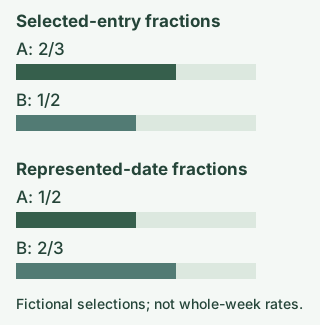
Use marked entries divided by all selected entries eligible for this question. Week A has two YES entries out of three: 2/3. Week B has six out of twelve: 6/12 = 1/2. Under this entry-based question, A has the larger fraction because two-thirds is larger than one-half.
Week B has more YES entries in absolute terms, six rather than two, but it also contains four times as many selected entries. Comparing six with two answers a count question. Comparing 6/12 with 2/3 answers a share-of-selected-entries question. Keep those statements separate.
The denominator is not seven days, all task starts that week or the number of words in the journal. It is the number of distinct eligible selected entries. The records do not establish how many unrecorded task starts there were, so an all-task-start fraction cannot be calculated from this table.
| Selection | YES entries | Eligible selected entries | Entry fraction |
|---|---|---|---|
| Week A | 2 | 3 | 2/3 |
| Week B | 6 | 12 | 6/12 = 1/2 |
Second question: which represented dates contain at least one YES?
Now group entries by their date within each week. A contains dates 1 and 2. Date 1 has A1 and A2, both YES, but counts once as a date containing at least one YES. Date 2 has A3, marked NO. The date-based result is one marked date out of two represented dates: 1/2.
B contains six represented dates. Dates 1, 2, 3 and 4 each contain at least one YES; dates 5 and 6 contain only NO entries in this selection. Three YES entries on date 4 still produce one marked date. The result is four marked dates out of six represented dates: 4/6 = 2/3.
Under this represented-date question, B has the larger fraction. That reverses the ordering from the entry question. The arithmetic did not contradict itself: the unit and question changed. This rule asks whether a represented date has at least one YES, not whether every event on that date had that order.
| Selection | Dates with at least one YES | Represented dates | Date fraction |
|---|---|---|---|
| Week A | 1 | 2 | 1/2 |
| Week B | 4 | 6 | 4/6 = 2/3 |
Explain the reversal without turning it into a finding about the week
The entry calculation lets a date with three entries contribute three observations. The represented-date calculation lets that date contribute one date. In B, dates 5 and 6 each contribute three NO entries; together they contribute six NO entries but only two represented dates. In A, the two YES entries are concentrated on one date. Those distributions explain the two different answers.
Choose the question that fits the reader’s purpose before selecting the result you prefer. If you need both views, present both with their labels. Do not pick the larger fraction afterward and describe it as a more accurate version of the other one.
Neither result shows a week-to-week improvement, a stable habit, a cause or the proportion of every day or event in either week. Week A has no selected notes for five of its seven dates; B has no selected note for one date. Those unrepresented dates are not observed NO dates. Even a represented date may contain other unrecorded task starts.
Check three tempting shortcuts against the complete records
These checks use the same invented selection. The purpose is to preserve the record identity, unit and missing information. They do not add real observations or require you to track another week.
Case 1
A second saved copy of A2 is added to the file. Should A now have three YES entries out of four?
Show answer and explanation for case 1
No. A still has two YES events out of three distinct eligible entries.
The added row is a copy of an existing event with the same ID. Counting copies would produce 3/4 from the file rows, but it would answer a different and misleading file-copy question. Deduplicate the copy before counting events.
Case 2
A has a YES record on day 1 and no selected notes on days 3–7. Can the result be described as YES on one of seven observed days?
Show answer and explanation for case 2
No. Only two dates are represented in A, with one containing at least one YES.
The five missing dates were not observed by this selected set. The represented-date fraction is 1/2; it cannot be relabelled as a measured whole-week fraction or filled with five NO dates.
Case 3
B has six YES entries while A has two. Does that prove the sequence became more common in the whole week?
Show answer and explanation for case 3
No. It establishes a larger absolute count in this fictional selected record set.
The selected-entry fractions are B 6/12 and A 2/3, while the represented-date fractions order them differently. The unrecorded events and selection process do not supply a whole-week comparison.
Write a limited conclusion and retain a short calculation record
A faithful conclusion is: “In these selected notes, A has the larger share of marked entries, 2/3 compared with 1/2. B has the larger share of represented dates with at least one mark, 2/3 compared with 1/2. Several entries share dates, and unrecorded dates or events remain unknown. Neither comparison describes the complete weeks.”
If your own question does not need both fractions, keep the matching one and its exact unit. If an essential distinction is unknown, leave the comparison unanswered. A short note saying “I do not know whether these are distinct events” is better than a precise-looking count of uncertain copies.
The blank record below is optional. Keep it in a location you choose; this page does not receive the entries you write into a separate text file. The plain-text notes guide explains faithful copies and later additions. The weekly journal review works through a single bounded selection without needing a two-week comparison.
You can stop after the comparison or skip counting entirely. A numerical summary of personal notes is not a diagnosis, a treatment evaluation or a reason to continue an exercise that has become burdensome.
Sources and further reading
- Mindful Clarity: what a pattern isExplains why selected observations, repeated words and missing events do not establish a cause. This guide supplies its own fictional records and arithmetic.
- Mindful Clarity: weekly journal reviewA separate format for reviewing one limited selection of notes. It explains entries, dates and exceptions; the two-week dataset and calculations here are original illustrations.
- Mindful Clarity: keeping reflection notes in plain textHow to preserve labels, wording, unknowns and later additions in a separate copy. A copied file is not an additional recorded event.