Practice worksheet
Thoughts, Feelings, Urges and Actions: A Sorting Worksheet
A thought is something your mind says or pictures; a feeling is the emotional experience you notice; an urge is a pull toward doing something; an action is what you actually do. Write them separately to make one moment easier to describe. You can feel angry without shouting, want to send a message without sending it, or take a useful action while a difficult feeling remains.
Use four columns as writing aids
| Column | Ask yourself | Example wording | Keep separate |
|---|---|---|---|
| Thoughts | What words or images came to mind? | “They will be disappointed.” | A prediction is not a confirmed account of another person's response. |
| Feelings | What emotion words fit my experience? | Worried, sad, relieved, pleased; or unsure. | An emotion word and a body sensation describe different aspects. Label body notes separately if useful. |
| Urges | What did I want or feel pulled to do? | “I wanted to leave.” | Wanting to leave does not establish that you left. |
| Actions | What did I actually do? | “I asked for more time.” | A possible next action is different from an action already taken. |
These are practical categories for a short record. They are not four independent systems or a fixed sequence that every experience follows. Thoughts, feelings and behaviour can influence one another, and you may notice some parts more clearly than others.
The NHS describes mindfulness as noticing thoughts, feelings, body sensations and the world around you. It also describes a CBT thought record that examines thoughts and feelings with seven prompts. This original four-column sorting sheet serves a narrower task: describe what belongs in each part before deciding what to do with it. It is not that complete seven-prompt exercise or a validated assessment. [1] [2]
Write the event outside the four columns
Begin with one event you can describe. “My friend has not replied since yesterday” reports what you know. “My friend is deliberately ignoring me” adds an interpretation of intention. Put the interpretation in the thought column, where it can remain a question rather than an assumed fact.
A thought can be accurate, partly accurate or mistaken. A feeling is something you experienced; the interpretation linked to it may still need checking. Sorting does not require doubting every perception, explaining away unfair treatment or becoming cheerful about a real problem.
Keep the time window small: one conversation, notification or task moment. A record of “everything that happens to me” becomes hard to separate. If you only remember the action, write that and leave the other parts uncertain instead of filling them with guesses.
Unpack wording that blends categories
“I feel that they do not respect me”
This sentence contains an interpretation about someone else's attitude. You might write the thought as “They do not respect me” and the feeling as hurt, angry or disappointed—if those words fit. The aim is to clarify the statement, not to tell someone their experience is wrong.
“I feel like walking out”
This usually describes an urge. The feeling might be overwhelmed, irritated, scared or something else. The action column could say “I stayed,” “I asked for a break” or “I left,” depending on what actually happened.
“I am a failure”
This is a self-judgment, rather than an emotion name. Record the exact words in thoughts, then use an emotion word if you can. “I felt ashamed after missing the deadline” gives different information from treating a whole identity as the event.
Language is flexible. A phrase such as “feeling unwelcome” can carry both emotion and interpretation. You do not have to correct every phrase perfectly. Split it only when doing so makes the record more understandable. Use “mixed,” “unsure” or your own words when that is more honest.
Six everyday sorting examples
These are original fictional situations. The answers sort the information given; they do not infer what a real person must feel. Different emotion words may fit your own situation, and a possible action is not a prescription.
Case 1
A friend has not replied since yesterday. You think, “They have forgotten me.” You feel lonely and disappointed. You want to send several follow-up messages. You open the chat once and leave it without sending. Sort these four parts.
Show answer and explanation for case 1
Thought: “They have forgotten me.” Feelings: lonely and disappointed. Urge: send several follow-ups. Action: opened the chat and left without sending.
The lack of a reply is the event. The friend’s intention remains unknown. Wanting to send is separate from sending; record what happened without claiming the thought was confirmed.
Case 2
In a meeting, someone asks you to explain a chart. “Everyone will think I am incompetent” comes to mind. You feel nervous and notice warm cheeks. You want to stop speaking. You ask which part of the chart needs explaining. How would you record it?
Show answer and explanation for case 2
Thought: the prediction about everyone’s judgment. Feeling: nervous; optional body note: warm cheeks. Urge: stop speaking. Action: asked which part needed explaining.
Keep the body note distinct from the emotion word. The question you asked is an action already taken, not proof the nervousness vanished or that others agreed with the prediction.
Case 3
Music outside interrupts your reading. You think, “It is too noisy for me to concentrate here.” You feel irritated and notice tense shoulders. You want to leave the room. You close the window. Sort the record without forcing the thought to become positive.
Show answer and explanation for case 3
Thought: the statement about concentration in this setting. Feeling: irritated; optional body note: tense shoulders. Urge: leave. Action: closed the window.
The thought may describe a real environmental problem. This exercise does not classify every thought as inaccurate. Closing the window and leaving are different behaviours; write only the one that occurred.
Case 4
You receive another invitation during a busy week. “Declining would make me rude” appears. You feel guilty and tired. You want to agree immediately. Instead, you reply that you will check your availability and answer tomorrow. What goes in each column?
Show answer and explanation for case 4
Thought: the interpretation that declining would be rude. Feelings: guilt; tiredness can be recorded as a separate state. Urge: agree immediately. Action: replied with a time to answer.
An action can create time to decide without removing guilt. Record tiredness in the wording that helps you, rather than forcing every state into an exact emotion label. The table does not decide whether to accept.
Case 5
You send a work email without its attachment. “I never get anything right” comes to mind. You feel frustrated and embarrassed. You want to hide the mistake. You send the missing attachment with a short correction. Separate the four parts.
Show answer and explanation for case 5
Thought: the broad self-judgment. Feelings: frustrated and embarrassed. Urge: hide the mistake. Action: sent the attachment with a correction.
The actual mistake can be recorded without treating the sweeping judgment as a fact. Repairing the email is an action, even if embarrassment remains. Sorting does not erase responsibility for what occurred.
Case 6
A colleague thanks you for helping with a task. You think, “My contribution was noticed.” You feel pleased. You want to share the news with a friend. You thank the colleague; you have not contacted the friend. Sort this positive moment.
Show answer and explanation for case 6
Thought: “My contribution was noticed.” Feeling: pleased. Urge: share the news. Action: thanked the colleague; no message to the friend yet.
The same distinctions apply to pleasant experiences. You do not need a problem, a negative thought or an emotional change to use the worksheet. A possible later action stays separate from what you already did.
Fill a one-moment four-column record
Download the original printable four-column sheet (SVG) or copy the plain-text record (TXT). You can also use the table below on paper or in your own notes. No numerical score is needed.
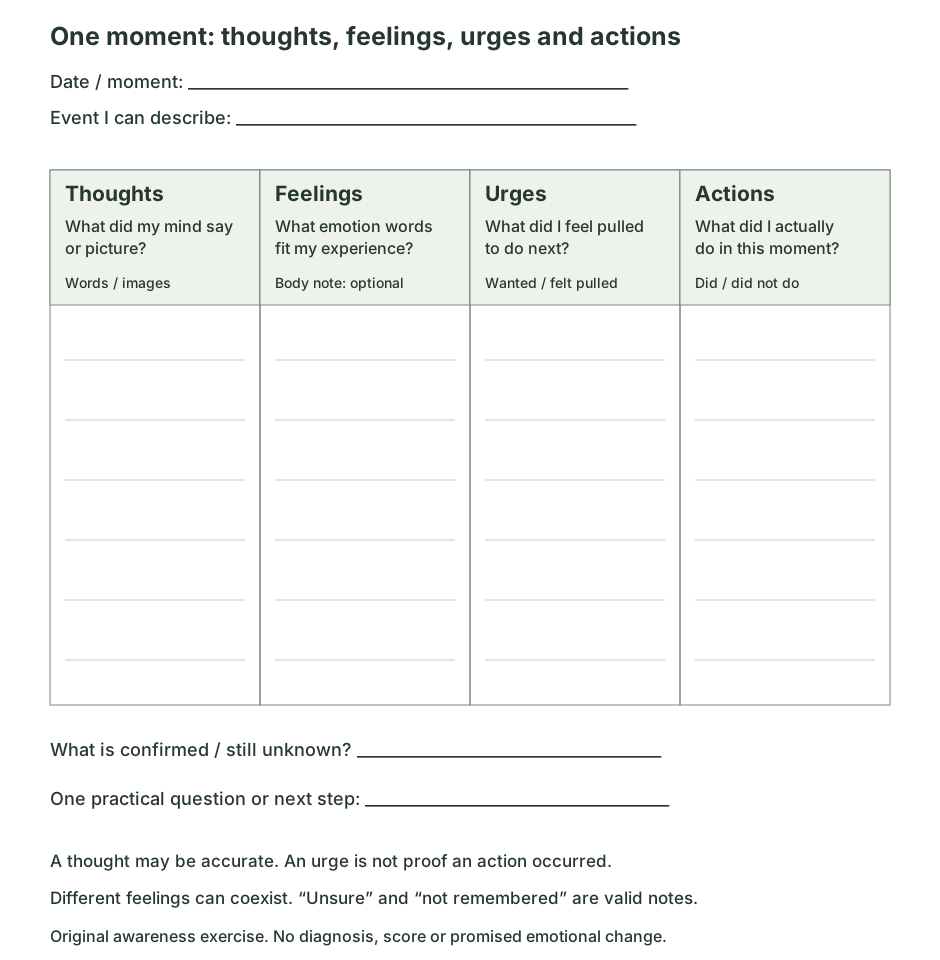
Event and approximate time: __________________________________________
| Thoughts | Feelings | Urges | Actual actions |
|---|---|---|---|
| Words or images that came to mind: __________________ | Emotion words, or unsure: __________________ Optional body note, separately labelled: __________________ | What I wanted or felt pulled to do: __________________ | What I did, and what I did not do: __________________ |
Confirmed information: __________________________________________
Still unknown: __________________________________________
One practical question or possible next step: __________________________
Keep the last line separate from past actions. “Ask about the deadline tomorrow” is a plan; “asked about the deadline this afternoon” records something completed. If you have not acted yet, say so. If you have several urges, list them without assuming you must choose one immediately.
Use the record without making a verdict about yourself
Read one completed row and check for the distinction that matters. Did an urge become an action? Is an interpretation written as though it were confirmed? Does the action need a practical repair or follow-up? You can answer these questions without rating the feeling as good or bad.
For example, after the missing-attachment case, the correction addresses the practical mistake. The broader thought “I never get anything right” would need its own examination if you want to explore it. The NHS's seven-prompt thought record provides a separate, more structured approach to examining evidence and possible alternatives. You do not need to bolt every prompt onto this sorting sheet.
The next useful step can be rest, clarification, a boundary, repair, seeking support or doing nothing further for now. Noticing is not a demand to become more productive. The record also does not establish why a thought appeared, another person's intentions or a mental-health diagnosis.
Keep the exercise short and optional
One understandable entry is enough. If you keep rewriting it to obtain certainty or the “correct” emotion, stop the exercise and return to the situation's practical needs. You do not have to force attention inward or stay with a practice that makes you feel worse. The NHS notes that mindfulness is not helpful for everyone. [1]
WHO's Doing What Matters in Times of Stress is a broader illustrated stress-management resource with accompanying audio exercises. Its publication page describes that guide as informed by evidence and field testing; that description does not validate this original worksheet or guarantee a result from it. [3]
If distress or repeated behaviour is interfering with daily life, use qualified support rather than treating a worksheet as a substitute. A useful record clarifies what you noticed and did. It can be complete even when a feeling remains or some details are unknown.
Sources and further reading
- NHS: MindfulnessNoticing thoughts, feelings and body sensations; naming mental events; mindfulness may not suit everyone. This worksheet is an original awareness exercise, not a mindfulness-based therapy.
- NHS Every Mind Matters: Thought recordA separate seven-prompt CBT exercise examines thoughts, feelings, evidence and alternatives. The original four-column sheet here does not reproduce or replace that full process.
- WHO: Doing What Matters in Times of Stress — publication and download pageA broader illustrated stress-management guide and accompanying audio resources. The publication-page description applies to the WHO guide, not to this site’s original worksheet.