Practice worksheet
Returning to a Task After Distraction: A Brief Attention Exercise
When you notice that your attention has moved away, check what needs your attention now. If the original task still matters, find where you stopped and choose one concrete operation. This brief exercise includes a return-to-task card and an optional record. You can respond to a necessary interruption, rest or stop instead of forcing another round.
A useful return has a place and an action
“Get back to work” leaves several questions unanswered: which task, where in it, and what to do next? A useful return might be “read the paragraph under Attachments,” “type the final question in the draft,” or “put the clean plates in the cupboard.” You can identify the operation without first making your mind completely quiet.
This exercise is for ordinary moments when you notice that reading, writing or another chosen activity has slipped out of view. It does not explain every cause of distraction, assess attention disorders or establish that continuing is the right choice. A necessary interruption, lack of information or a need for rest can change the next step.
The World Health Organization’s Doing What Matters in Times of Stress describes refocusing on everyday activities and the world around you. In Part 1, printed pages 32–33 discuss returning to the activity; pages 39–42 discuss attention to surroundings and explain that these practices do not remove difficult feelings. The NHS mindfulness introduction also describes bringing attention back when it wanders, while noting that mindfulness is not suitable or helpful for everyone.
The card below is this site’s original task-resumption exercise. It is not a reproduction of the complete WHO grounding exercise, a validated attention measure or a promise of improved productivity.
Try the brief return-to-task card
Use the steps once, at a pace that feels workable. No countdown, closed eyes, held breath or particular feeling is required. Keep attention on an accessible cue in the activity or your surroundings.
- Notice the switch. A short description such as “I am looking at a different tab” is enough. You do not need a full account of why it happened.
- Choose the current priority. Does the original task still need you now? Resume it, respond to a real interruption, pause or ask for help as appropriate.
- Locate the task. Find the document, object or materials. Identify the last completed point or the next uncompleted part.
- Do one concrete operation. Read one selected paragraph, write a known line or move one item. If the task is blocked, the operation may be asking a specific question.
- Check what is practical. Continue if the task is usable. Otherwise change the setup, rest, seek the missing information or stop. One return does not commit you to an extended session.
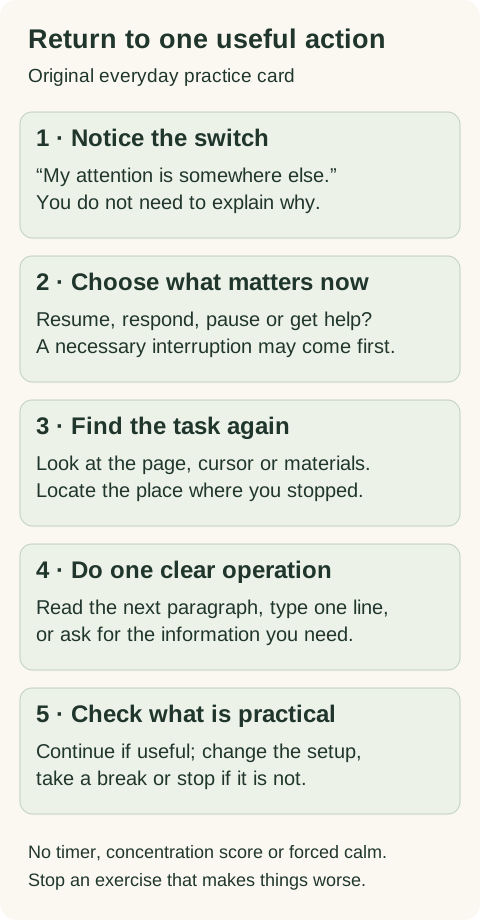
Download the attention card as SVG or download the plain-text card and optional record.
Worked example: a document after scrolling
Imagine that you are reading instructions for a form, open social media, and later notice that the form is unfinished. The visible evidence is a switch between activities. It does not tell you your character, your intentions or the cause of every difficulty concentrating.
Close or leave the optional feed if you choose to resume the form. Open the instructions and find the last heading you remember. Suppose the next paragraph explains an attachment. Your first operation is to read that paragraph and identify the required file, rather than complete the entire application at once.
If you discover that the file is missing, the useful next step changes. Locate the file or ask where to obtain it. Repeating the attention exercise will not supply information that the task requires.
A brief restart marker could be “Attachments paragraph: identify file.” That marker is enough to recover the position; it does not need the applicant’s name, identification number or private circumstances. The journal privacy guide explains why the details and location of a note matter when others might see it.
Choose an environmental cue that identifies the next step
Choose a cue you can actually find: a page heading, the cursor beside an unfinished line, a bookmark, an object needed for the next operation or an accessible equivalent such as a spoken reminder. The cue works as a pointer. It does not have to be a special object or a signal that makes you calm.
| Task | Useful cue | Next operation |
|---|---|---|
| Reading | Bookmark or current heading | Read the next selected paragraph. |
| Writing | Cursor and a neutral draft note | Write the next known line. |
| A form | Name of the missing item | Find that item or ask a precise question. |
| Putting things away | One item and its agreed place | Put that item where it belongs. |
| A conversation | The other person’s current question | Listen or ask them to repeat what you missed. |
Reduce an optional interruption when you have the choice: leave an unrelated tab, move a nonessential feed out of view or pause optional alerts using your normal settings. Keep communication you need for the situation available. Some environments cannot be made quiet, and a workable step may be changing the arrangement or asking for an uninterrupted interval.
If a reminder becomes familiar enough to overlook, revise what it points to. “Next: final question” is more concrete than “Concentrate.” Avoid filling the workspace with repeated demands to stay focused.
Six situations: what should attention return to?
These are fictional examples for comparing next steps. They are not a concentration test. Try a response, then open the explanation.
Case 1
After checking social media, you return to a document but cannot remember where you stopped. What would make the next action specific?
Show answer and explanation for case 1
Locate the stopping point before trying to read more.
Use the last paragraph you recognize, a heading or a saved cursor position. Choose one next paragraph. “Focus harder” does not identify where to resume.
Case 2
You leave your email draft because someone you care for needs help. Should you ignore them until you complete the five steps?
Show answer and explanation for case 2
Respond to the real need and leave a small restart marker if practical.
Returning to attention can mean paying attention to the person who needs you. A neutral note such as “draft: final question” can help you find the unfinished task later.
Case 3
You have reread the same sentence several times and feel tired. Does the card require another uninterrupted round?
Show answer and explanation for case 3
No. Rest or a different arrangement may be the useful next choice.
The exercise does not establish why concentration is difficult. Check the practical conditions instead of treating repeated rereading as evidence that you need stricter practice.
Case 4
You keep switching away from a form because one required field asks for information you do not have. What should the next operation be?
Show answer and explanation for case 4
Find or request the missing information.
A task can be blocked even when you are attending to it. “Complete the form” is too broad here; identify the missing item and the appropriate place to obtain it.
Case 5
A note beside the keyboard reads “Never get distracted.” How could you make it more usable?
Show answer and explanation for case 5
Replace the judgment with a concrete restart cue.
For example: “Open the reading page; start at the next heading.” A reminder should point to an available action, not demand permanent concentration or display private details.
Case 6
You return to the page once, but another thought appears. Does that make the first return a failed practice?
Show answer and explanation for case 6
No. Notice what happened and choose the next practical action.
You can return again if it is useful. You can also change the task, reduce an optional distraction, rest or ask for support. There is no pass mark for keeping thoughts away.
Keep only the record that helps you resume
You can use the exercise without writing anything. If a note helps, record the task, stopping point, cue, next operation and what actually happened. Leave uncertain details blank. “I returned to the paragraph but needed the missing file” describes an outcome more clearly than “I was bad at focusing.”
Task chosen now:
Where I stopped:
Cue I can find:
One next operation:
What actually happened:
Next choice: continue / change setup / break / ask / stop
Use one entry for one actual attempt if you want to review it. No daily streak, number of distractions or concentration rating is required. You can discard the note when it no longer helps, while following any recordkeeping duties that apply to the real task.
The thoughts, feelings, urges and actions worksheet serves a different purpose: separating types of experience. If a record says “I will never finish,” that is a thought; opening the document is an action. You do not need to complete that worksheet before returning to a task.
When another round is not useful
If attention moves away again, you may repeat a small return when it remains useful. There is no requirement to suppress the next thought or stay with the activity for a particular number of minutes. Check whether the operation is clear and whether the current conditions permit it.
Repeated attempts can reveal a practical obstacle: an unclear instruction, an inaccessible format, noise, a needed conversation or a task that is too large for the current time. Address that obstacle rather than extending the exercise automatically. Rest and asking for assistance are available choices.
Stop or change an exercise that increases distress, discomfort or self-criticism. If attention difficulties or distress persist and interfere with ordinary responsibilities, discuss them with an appropriate qualified professional. A private practice card cannot assess their cause or replace support. For a broader decision about competing actions, see how to notice a choice point.
Sources and further reading
- World Health Organization: Doing What Matters in Times of Stress – An Illustrated Guide (2020, English PDF)Part 1, printed pages 32–33 and 39–42: engagement with an activity, refocusing on surroundings and the limits of removing difficult feelings. This site’s original card is not the complete WHO exercise.
- NHS: MindfulnessPresent-moment attention, returning when the mind wanders and the qualification that mindfulness is not right or helpful for everyone.